San Diego County Judicial Records are official documents created and maintained by the Superior Court of California, County of San Diego. These records include civil, criminal, family, probate, small claims, and traffic case files. They serve as legal proof of court proceedings, judgments, motions, and case outcomes. Anyone can request access to most of these records because they are considered public under California law. However, some sensitive cases, like juvenile matters or sealed records, may have restricted access. The court system ensures transparency while protecting privacy rights. Records date back to the late 1800s, with digital access available for cases from 1974 onward. Physical archives go back even further, stored in ledger format from 1880.
The Superior Court operates multiple locations across the county, with the Central Records Department located at the main courthouse in downtown San Diego. This department manages all archived and active case files. Digital access is provided through the court’s online portal, allowing users to search by name, case number, date, attorney, or judge. While many records are free to view online, certified copies or printed documents may require a small fee. The system supports background checks, legal research, property disputes, and personal verification. Both individuals and legal professionals rely on these records for due diligence and case preparation. Access methods include online tools, mail requests, and in-person visits. Each method has specific procedures and requirements to ensure accurate retrieval.
Types of San Diego County Judicial Records
San Diego County Judicial Records cover a wide range of legal matters handled by the Superior Court. These records are categorized by case type and include detailed documentation of court actions. Each category follows specific legal procedures and retention rules. Understanding the types helps users identify which records they need and how to locate them.
Civil Court Records
Civil court records involve disputes between individuals or organizations, typically over money, property, or contracts. These cases do not involve criminal charges but can result in financial judgments or injunctions. Common examples include landlord-tenant disputes, personal injury claims, and business disagreements.
- Small Claims Cases: Handle disputes under $12,500. Records include plaintiff and defendant names, claim amount, hearing date, and judgment.
- Unlimited Civil Cases: For claims over $25,000. These files contain detailed pleadings, motions, trial transcripts, and final rulings.
- Family Law Cases: Include divorce, child custody, spousal support, and domestic violence restraining orders. These records are often sensitive and may require special access.
Criminal Court Records
Criminal records document offenses prosecuted by the state, ranging from minor infractions to serious felonies. These files include arrest details, charges, court appearances, and sentencing outcomes. They are frequently used for background checks and employment screening.
- Misdemeanor Cases: Less serious crimes with penalties up to one year in jail. Records show charge code, arrest date, plea, and sentence.
- Felony Cases: Serious crimes like robbery, assault, or drug trafficking. These records include indictment details, trial transcripts, and prison terms.
- Traffic Violations: Include DUIs, speeding tickets, and reckless driving. These are often resolved without trial but remain on record.
Probate and Juvenile Records
Probate records deal with wills, estates, guardianships, and conservatorships. Juvenile records involve minors in dependency or delinquency cases. Both types have stricter access rules due to privacy concerns.
- Probate Files: Contain wills, asset inventories, beneficiary lists, and court approvals. Used in inheritance disputes.
- Guardianship Cases: Show appointment of legal guardians for minors or incapacitated adults.
- Juvenile Delinquency: Sealed in most cases. Only law enforcement or court officials can access them without a court order.
How to Search San Diego County Judicial Records Online
The Superior Court of San Diego County provides a free online case search tool for public use. This system allows users to find civil, criminal, and traffic records without visiting a courthouse. It is updated daily and includes cases from 1974 to the present. The search function is user-friendly and requires only basic information to begin.
Using the Online Case Search Tool
The primary method for searching records is the court’s official online portal. This tool is available 24/7 and does not require registration. Users can search by multiple criteria, including name, case number, or date. Results are displayed instantly and include key case details.
- The official search page: https://www.sdcourt.ca.gov/
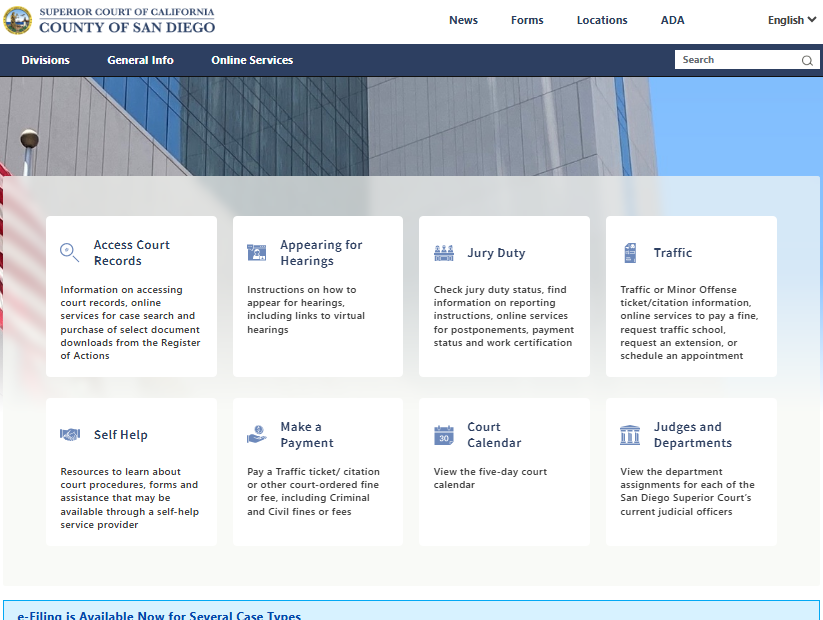
- Type the full name of a party in the “Party Name” field. Use last name first, followed by a comma and first name (e.g., Smith, John).
- Select the case type from the dropdown menu (Civil, Criminal, Traffic, etc.).
- Click the “Search” button to view results.
The system will return a list of matching cases. Each entry shows the case number, filing date, case type, status (active or closed), and parties involved. Clicking on a case number opens a detailed docket with all filings, hearings, and judgments.
Searching by Case Number
If you have a specific case number, this is the fastest way to retrieve records. Case numbers follow a standard format: two letters, a year, and a sequence number (e.g., CIV2023001234).
- Navigate to the same online search page.
- Enter the full case number in the “Case Number” field.
- Leave other fields blank unless narrowing results.
- Press “Search” to load the complete case summary.
The output includes the case title, filing date, court location, assigned judge, and a chronological list of all documents filed. Users can view or download PDF copies of motions, orders, and judgments directly from the docket.
Searching by Date or Attorney
For legal professionals or researchers, searching by date or attorney name can help track case activity. This method is useful for monitoring court calendars or reviewing an attorney’s caseload.
- On the search page, select “Date Range” and enter a start and end date.
- Choose “Attorney Name” and type the full name as registered with the State Bar.
- Click “Search” to see all cases matching the criteria.
Results display case numbers, parties, and hearing dates. This tool does not show full documents but provides enough detail to request specific files. It is ideal for scheduling or case monitoring.
Accessing Records by Mail or In Person
Not all records are available online, especially older cases or sealed documents. For these, you must contact the court directly by mail or visit in person. The Central Records Department handles all non-digital requests and provides certified copies when needed.
Mailing a Request for Records
To request records by mail, send a written letter with specific details to the court’s mailing address. Include as much information as possible to speed up processing. The court will respond with available records or a fee estimate.
- Address: PO Box 121750, San Diego, CA 92112
- Include: Full names of parties, case number (if known), case type, and date range.
- Specify if you need certified copies, which require a fee.
- Enclose a self-addressed stamped envelope for return documents.
Processing takes 7 to 14 business days. Certified copies cost $25 per document, plus $0.50 per page for printing. Payment must be by check or money order made payable to “San Diego Superior Court.”
Visiting the Central Records Department
For immediate access, visit the Central Records Department at the main courthouse. Staff can assist with searches and provide copies on-site. This is the best option for urgent requests or complex cases.
- Location: 220 W Broadway, Room 2005, San Diego, CA 92101
- Bring a valid photo ID and case details.
- Use public terminals to search records before requesting files.
- Request copies at the service window; fees apply for printing and certification.
The department holds criminal records from 1974 and civil records in ledger format from 1880. Staff can retrieve files within minutes for recent cases. Older records may require a wait time of up to one hour.
Requesting Certified or Sealed Records
Certified copies are official documents with a court seal, often required for legal proceedings. Sealed records, such as juvenile cases, require a court order to access. Both types involve additional steps and fees.
- Certified Copies: Available for any public record. Cost $25 per document. Must be requested in person or by mail.
- Sealed Records: Only accessible with a judge’s order. Submit a petition to the court explaining the need for access.
- Expunged Records: May be available to the individual named in the case. Provide proof of identity and case number.
All requests are reviewed by court staff. Processing times vary based on volume and complexity. Certified documents are typically ready within 3 business days.
The Case Status and Court Calendars
Knowing the status of a case helps determine next steps, especially for legal proceedings or background checks. The court provides tools to track active cases and upcoming hearings. These resources are updated in real time and accessible to the public.
Checking Case Status Online
The online case search tool shows whether a case is active, closed, or on appeal. This information is critical for determining if further action is needed. Status updates occur after each court event.
- Search for the case using the name or case number.
- Review the “Case Status” field in the results.
- Common statuses include: “Active,” “Closed,” “Appealed,” or “Dismissed.”
- Click the case number to see the full docket and recent filings.
An active case may have upcoming hearings or pending motions. A closed case means all proceedings are complete. If a case is appealed, it has been sent to a higher court for review.
Viewing the Court Calendar
The court publishes daily calendars showing scheduled hearings, trials, and motions. These are available online and at each courthouse location. Calendars help parties prepare for appearances and avoid missed dates.
- Select the courthouse location and date.
- Enter a case number or party name to find specific hearings.
- Results show time, courtroom, judge, and case type.
Calendars are updated by 5:00 PM the day before. Changes can occur due to continuances or emergencies. Always confirm the schedule before attending court.
Interpreting Docket Entries
The docket is a chronological list of all actions in a case. Each entry includes a date, document type, and description. Understanding these entries helps track case progress.
| Entry Type | Description |
| Complaint Filed | Initial document starting the case. |
| Motion to Dismiss | Request to end the case before trial. |
| Hearing Set | Court date scheduled for argument or testimony. |
| Judgment Entered | Final ruling by the judge. |
| Appeal Filed | Case sent to appellate court. |
Each entry links to the actual document when available. Users can download PDFs of motions, orders, and transcripts. This level of detail supports legal research and case preparation.
Fees and Payment Methods
The San Diego Superior Court charges fees for certain services, including certified copies, document retrieval, and printing. These fees help cover administrative costs and are set by state law. Most online searches are free, but physical or certified documents require payment.
Standard Fee Schedule
Fees vary by service type and document size. The court provides a clear schedule to help users estimate costs before making requests. Payment must be made at the time of service or with mailed requests.
| Service | Fee |
| Certified Copy (per document) | $25.00 |
| Printing (per page) | $0.50 |
| Document Retrieval (per file) | $15.00 |
| Exemplification (court seal) | $25.00 |
| Online Search | Free |
Fees are non-refundable, even if no records are found. Payment methods include cash, check, money order, or credit card (in person only). Checks must be payable to “San Diego Superior Court.”
Waivers and Reduced Fees
Individuals with financial hardship may qualify for fee waivers. This applies to low-income residents, students, or those receiving public assistance. Waivers require documentation and court approval.
- Submit a Fee Waiver Request (Form FW-001) with income proof.
- Include a statement explaining the need for records.
- Court staff review and approve or deny within 5 business days.
- If approved, all fees for that request are waived.
Waivers do not apply to certified copies needed for legal proceedings outside the court. Each request is evaluated individually.
Payment at Courthouse Locations
When visiting in person, payment is accepted at the service window. Credit cards are accepted at all locations, but cash and checks are preferred for smaller amounts. Receipts are provided for all transactions.
- Request documents at the Central Records window.
- Receive a fee estimate based on the number of pages and services.
- Pay using cash, check, or credit card.
- Collect documents and an official receipt.
For large requests, such as entire case files, payment is due up front. The court does not offer payment plans. All fees are posted at each location for public viewing.
Legal Restrictions and Privacy Concerns
While most San Diego County Judicial Records are public, certain restrictions apply to protect privacy and ensure justice. The court balances transparency with the rights of individuals, especially in sensitive cases. Understanding these rules helps users know what they can and cannot access.
Sealed and Confidential Records
Some records are sealed by court order and not available to the public. This includes juvenile cases, adoption files, and certain family law matters. Access requires a judge’s approval and a valid reason.
- Juvenile Delinquency: Sealed automatically. Only law enforcement and court staff can view.
- Adoption Records: Confidential for 100 years. Birth parents and adoptees may request access under strict conditions.
- Domestic Violence Restraining Orders: May be sealed if safety is a concern.
To request access, file a petition with the court explaining the need. The judge reviews the request and may hold a hearing. If granted, limited access is provided under supervision.
Expunged and Dismissed Cases
When a case is dismissed or expunged, it is removed from public view but not destroyed. The individual named in the case may access their own records. Employers and background check companies cannot see these records.
- Expungement clears a conviction from the public record.
- The case still exists in court files but is marked “sealed.”
- The person can legally state they were not convicted.
- Access for the individual requires ID and case number.
Expunged records are not available through online searches. Requests must be made in person or by mail with proof of identity.
Redaction of Personal Information
To protect privacy, the court redacts sensitive information from public documents. This includes Social Security numbers, bank account details, and children’s names. Redaction is done before documents are released.
- SSN: First five digits removed.
- Bank Accounts: Full numbers hidden.
- Minor Names: Replaced with initials or “Minor 1.”
- Medical Records: Entirely removed from civil cases.
Redaction rules are enforced by court staff. Users cannot request unredacted copies without a court order. This ensures compliance with state privacy laws.
Common Uses for Judicial Records
People access San Diego County Judicial Records for many reasons, from personal verification to legal research. These records serve as reliable sources of truth in various situations. Knowing the common uses helps users prepare their requests effectively.
Background Checks and Employment
Employers and landlords often request criminal and civil records to screen applicants. These checks help assess risk and ensure safety. Records show arrests, convictions, and civil judgments.
- Criminal History: Reveals past offenses and sentencing.
- Civil Judgments: Shows debts or lawsuits against the person.
- Traffic Violations: Indicates driving behavior and DUIs.
Employers must follow federal and state laws when using records for hiring. They cannot discriminate based on sealed or expunged cases. Applicants have the right to dispute inaccurate information.
Legal Research and Case Preparation
Lawyers and paralegals use judicial records to build cases, find precedents, and track opposing parties. Access to dockets and filings supports strong legal arguments.
- Review past rulings in similar cases.
- Identify patterns in a judge’s decisions.
- Check if a party has a history of litigation.
- Prepare for hearings using prior motions and orders.
Records are also used in appeals to show errors in lower court decisions. Legal professionals rely on accurate and complete documentation.
Personal and Family Matters
Individuals access records for divorce, child custody, or inheritance issues. These documents help resolve disputes and prove claims.
- Divorce Decrees: Show asset division and custody arrangements.
- Probate Files: List heirs and estate distribution.
- Restraining Orders: Confirm legal protection status.
People may also check their own records to ensure accuracy. Errors can be corrected by filing a motion with the court.
| Address | 220 W Broadway, Room 2005, San Diego, CA 92101 |
| Phone | (619) 450-5700 |
| Hours | Monday–Friday, 8:00 AM – 4:00 PM |
FAQs About San Diego County Judicial Records
San Diego County Judicial Records provide official access to court case information across civil, criminal, family, and traffic matters within the Superior Court system. These records are maintained to ensure transparency in the judicial process and allow the public to track case progress, outcomes, and filings. Below are frequently asked questions that explain how to search, access, and understand these records effectively.
Can I search San Diego County Judicial Records for free?
Yes, the Superior Court provides a free online case search tool for civil, criminal, and traffic records. You can search by name, case number, date, or attorney. The system displays case number, filing date, status, and parties involved. Clicking a case number opens the full docket with all filings and hearings. No registration is required, and the tool is available 24/7. However, certified copies or printed documents cost money. Online viewing is always free, but downloading or printing may incur charges if done at the courthouse. The search covers cases from 1974 to the present. Older records are available in person at the Central Records Department.
How do I get a certified copy of a court document?
Certified copies have an official court seal and are required for legal use outside the court. To obtain one, visit the Central Records Department at 220 W Broadway, Room 2005, San Diego, CA 92101. Bring a valid ID and the case number. Request the specific document, such as a judgment or order. The fee is $25 per document, plus $0.50 per page for printing. Payment is accepted in cash, check, or credit card. Processing takes 1 to 3 business days. You can also request by mail to PO Box 121750, San Diego, CA 92112. Include a check, case details, and a self-addressed stamped envelope. Certified copies are not available online.
Are juvenile records available to the public?
No, juvenile records in San Diego County are sealed by law and not accessible to the public. These include delinquency and dependency cases involving minors. Only law enforcement, court staff, and authorized agencies can view them. Parents or guardians may access their child’s records with proof of relationship. To request access, file a petition with the court explaining the need. A judge will review and may grant limited access under supervision. Expunged juvenile records are also sealed and cannot be seen by employers or background check companies. The court protects minors’ privacy to support rehabilitation and reintegration.
What information is shown in a criminal court record?
A criminal court record includes the defendant’s name, arrest date, charge code, bail amount, court appearances, plea, and final sentence. It also lists the arresting agency, case number, and assigned judge. For felonies, the record may include indictment details, trial transcripts, and prison terms. Misdemeanors show similar data but with lighter penalties. Traffic violations include citation number, violation type, fine amount, and payment status. All entries are chronological and linked to official documents. The record does not include sealed or expunged cases. Users can search by name or case number online. Results display key facts but not full documents unless downloaded from the docket.
How far back do San Diego County court records go?
San Diego County court records date back to 1880, stored in physical ledger format at the Central Records Department. Digital records are available from 1974 to the present and can be searched online. Criminal records from 1974 onward are fully indexed and accessible. Civil records older than 1974 must be requested in person or by mail. The court maintains all active and closed cases indefinitely. Some very old records may be archived off-site and require advance notice for retrieval. The oldest surviving files include land disputes, probate cases, and early criminal trials. Researchers and historians can access these through supervised visits.